
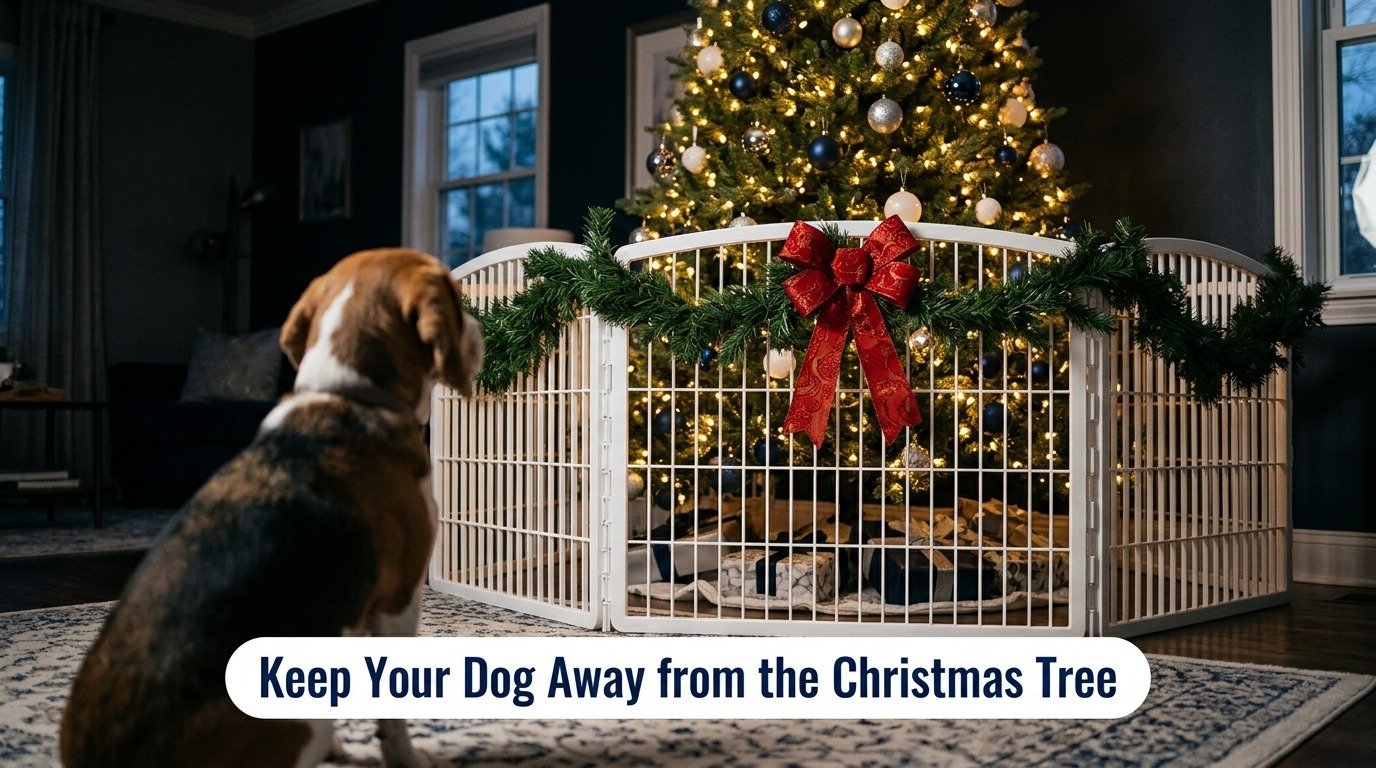
7 Ways to Keep Your Dog Away from the Christmas Tree
The tree goes up, the lights come on, and your dog decides it is the best thing that has ever happened in your living room. It smells like outside, it sparkles, and it has things hanging at tail height.
If your dog keeps sniffing, grabbing, climbing or knocking the tree, you don’t need to give up on having one. Most dogs can be kept away with a mix of smart placement, a simple barrier and a little training. Here are seven ways that work, starting with the easiest.
(If you want to know why a tree can be risky in the first place, we covered that in 6 Christmas Dangers for Dogs Every Owner Should Know About. This article is only about solutions.)
1. Choose the Spot Before You Build the Tree
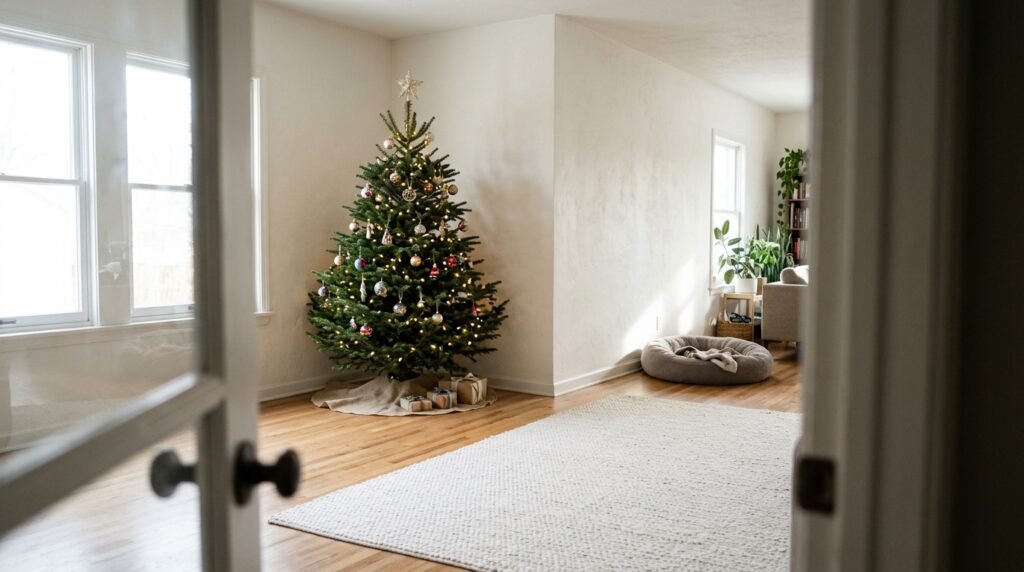
Where the tree stands decides half the battle. Before you open a single box, walk around the room the way your dog would.
Look for a corner with two solid walls on either side. A dog has fewer angles to reach, and the tree is less likely to be bumped. Avoid these spots:
- Next to the sofa or a low table. Dogs use furniture as a step to jump up and reach branches.
- On the main walkway. A tail swinging past the tree all day will eventually knock something.
- Near the dog’s bed or food bowl. The tree becomes part of their daily space, and that makes it very interesting.
- By a heater or vent. Warm air makes the tree dry out faster and the smell stronger.
If your living room is small, a corner by a window usually works best. Pull the tree a few inches away from the wall so a wagging tail doesn’t push it forward.
2. Put a Barrier Around It
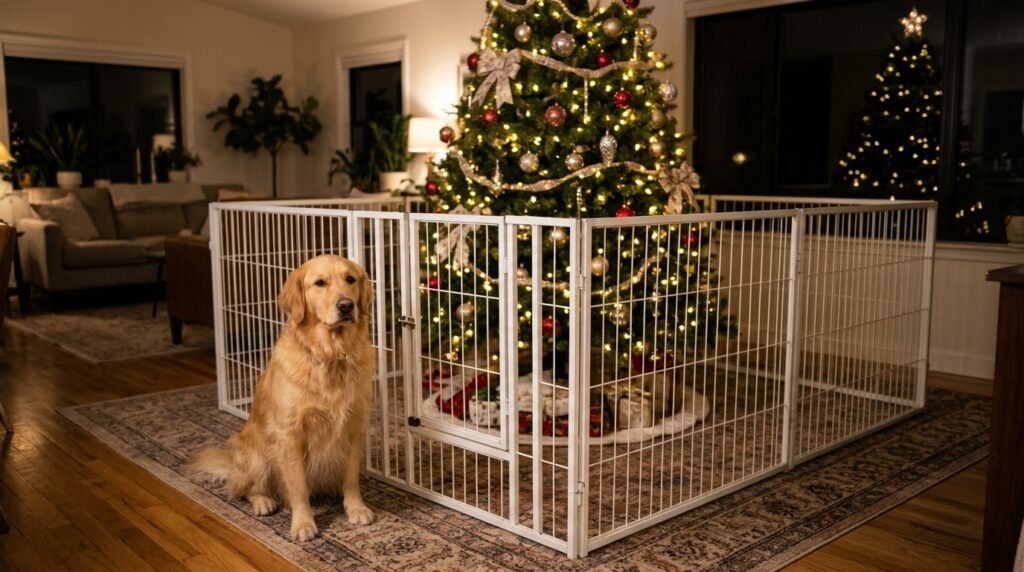
A barrier is the single most effective fix, and it works for almost every dog. If you only do one thing from this list, do this.
Options, from simplest to most flexible:
- A pet exercise pen. These are the metal fence panels sold for puppies. Set them up in a circle or square around the tree. They are tall, sturdy and easy to fold away in January.
- A baby gate across a corner. If your tree is in a corner, one or two gates can close it off without a full circle.
- A decorative fence. A small white picket fence or a rustic wooden tree collar looks pretty, and a tall one is hard for a small dog to jump.
- Closing the door. If the tree is in a room your dog can be kept out of, this is the easiest barrier of all. It works well when you can’t watch the tree.
Make it look good: A plain metal pen can look odd in a nice room. Wrap a garland around it, tie a few bows on the outside, or tuck a tree skirt over the lower edge. A pen with a garland looks like part of the display.
A barrier does not have to be forever. Many owners keep it up for the first week while the dog gets used to the tree, then lower it if their dog has lost interest.
3. Lift the Tree Up or Make It Impossible to Tip
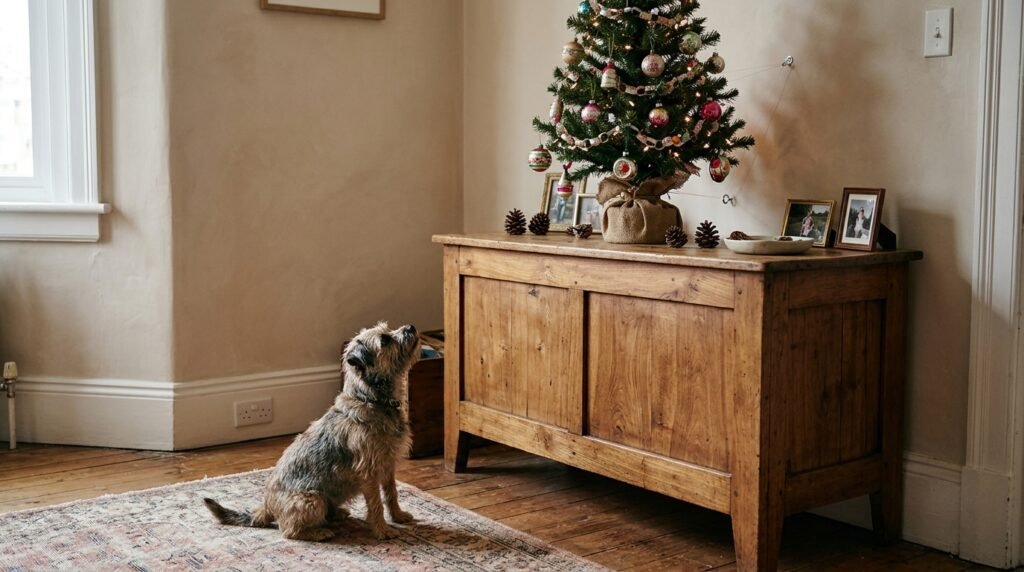
A tree that falls is scary for everyone, so give it a solid base.
- Use a heavy, wide stand. A cheap, narrow stand tips easily. A wide metal stand with a water reservoir is much steadier.
- Anchor the tree. Tie fishing line or strong cord from the trunk, about halfway up, to a hook in the wall or ceiling. You can barely see it, and it stops a tumble.
- Try a table-top tree. If your dog is a jumper or a very energetic puppy, a small tree placed on a high table, shelf or sideboard puts it out of reach. Make sure the table is sturdy, and that your dog can’t use a chair to climb up.
- Choose a slimmer or smaller tree. A tall, wide tree has far more to reach and more weight to fall. A slim tree in a corner takes up less room and is easier to secure.
4. Decorate with Your Dog in Mind

Think of the tree in three zones.
The bottom third (your dog’s zone): Keep it plain. Leave the lowest branches bare, or use only soft, unbreakable decorations such as felt or wooden ornaments that are too big to swallow. Don’t hang anything here that smells like food, such as candy canes, popcorn strings or gingerbread, because a food smell is an invitation.
The middle third: Use your regular ornaments, but fasten them with wire hooks or thin wire, not loose hooks that can fall off.
The top third: This is where fragile or sentimental pieces go.
A few more habits help:
- Wrap lights close to the trunk and start higher up, rather than letting them hang near the floor.
- Skip tinsel and thin ribbon, which are easy to grab.
- Hang a few decorations a little higher than usual, so your dog’s tail sweeps under them.
- A “bare” bottom looks a bit odd on its own, so cover it with a thick tree skirt or a basket, or surround it with presents that are empty boxes.
5. Make the Base Less Interesting
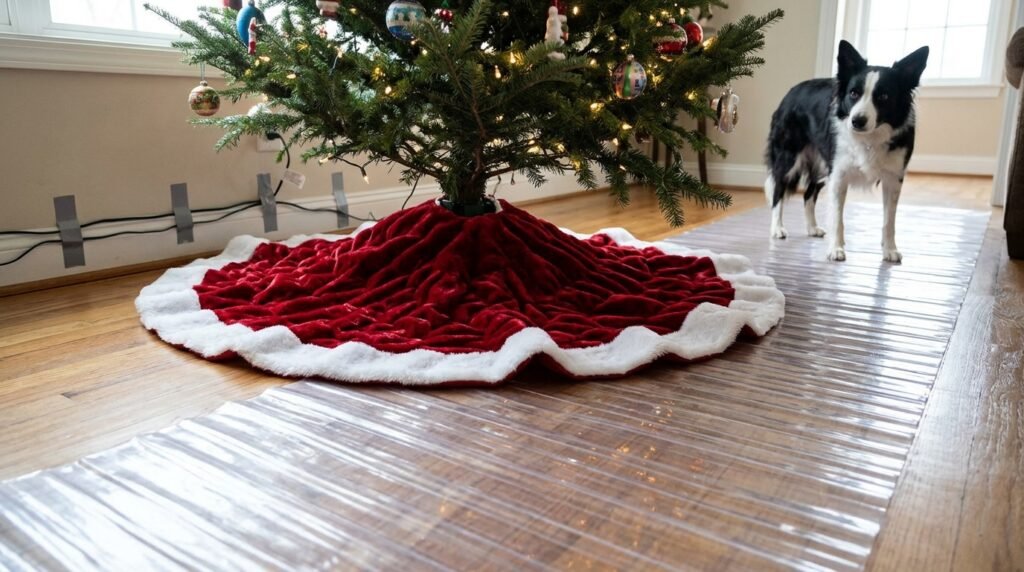
Dogs go where the fun is. A few simple tricks can make the bottom of the tree less appealing.
- Cover the water. Use a full-length tree skirt or a lid so your dog can’t drink from the stand.
- Add a “no-go” surface. Many dogs dislike walking on sticky or crinkly surfaces. Lay a wide strip of double-sided pet-training tape or a plastic carpet runner (nubby side up) on the floor around the base. Test it first so your dog isn’t scared.
- Use a pet-safe deterrent spray. Bitter-tasting sprays made for dogs can be sprayed on the tree skirt or on cords (not directly on the tree, and test a small area first). Always follow the label.
- Protect the cords. Use cord covers or run the wires along the wall, and unplug the lights when you’re out.
A note on home remedies: Avoid essential oils, cayenne pepper and mothballs. Many oils, especially pine, citrus and peppermint, can be harmful to dogs, and pepper can burn their eyes and nose. Stick to products made for dogs.
6. Teach Two Simple Cues: “Leave It” and “Place”
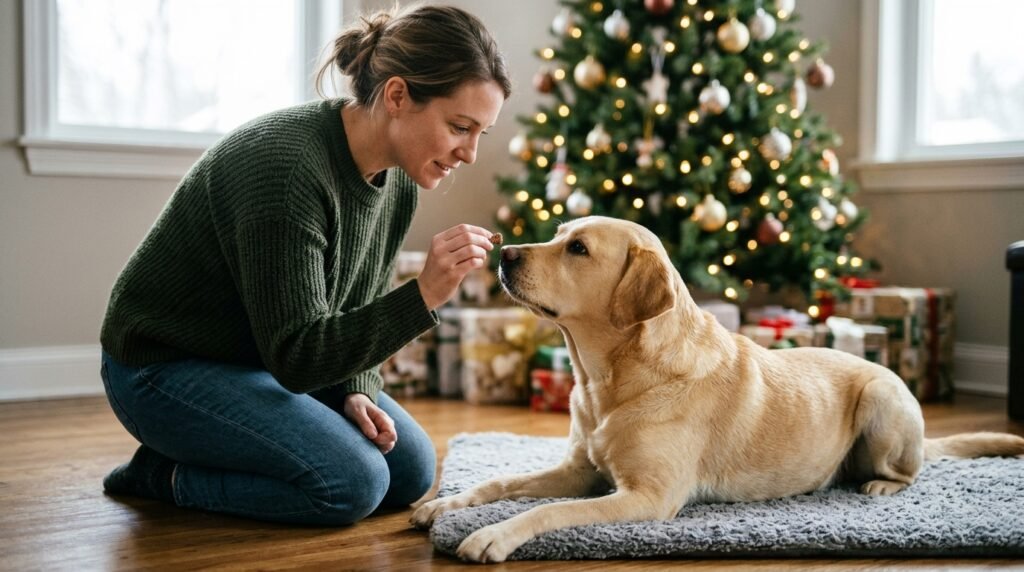
Barriers help, but training makes the whole holiday easier. You only need two cues, and both can be taught in a few short sessions.
“Leave it”
- Put a treat in your closed hand and let your dog sniff it.
- The moment your dog stops trying to get it and looks away, say “yes” and give a different treat from your other hand.
- Practise until your dog backs off the second you say “leave it.”
- Next, try it with a low-value object on the floor, like a dry biscuit under your hand, then uncovered.
- Finally, practise near the tree, rewarding every time your dog looks at it and then looks at you.
“Place”
- Put a mat or dog bed a few steps from the tree, in a spot where your dog can still see you.
- Lure your dog onto it with a treat and say “place.”
- Reward for staying there for a few seconds, then slowly increase the time.
- Practise during the day, until “place” means a calm rest on the mat.
Keep sessions to 5 minutes. Use small, soft treats and stay patient. Most dogs make progress within a few days, but puppies need more repetition.
What not to do: Don’t shout or chase your dog away from the tree. This can make the tree exciting, or it can teach your dog to grab things and run. Calm redirection is much more effective.
7. Give Your Dog Something Better to Do
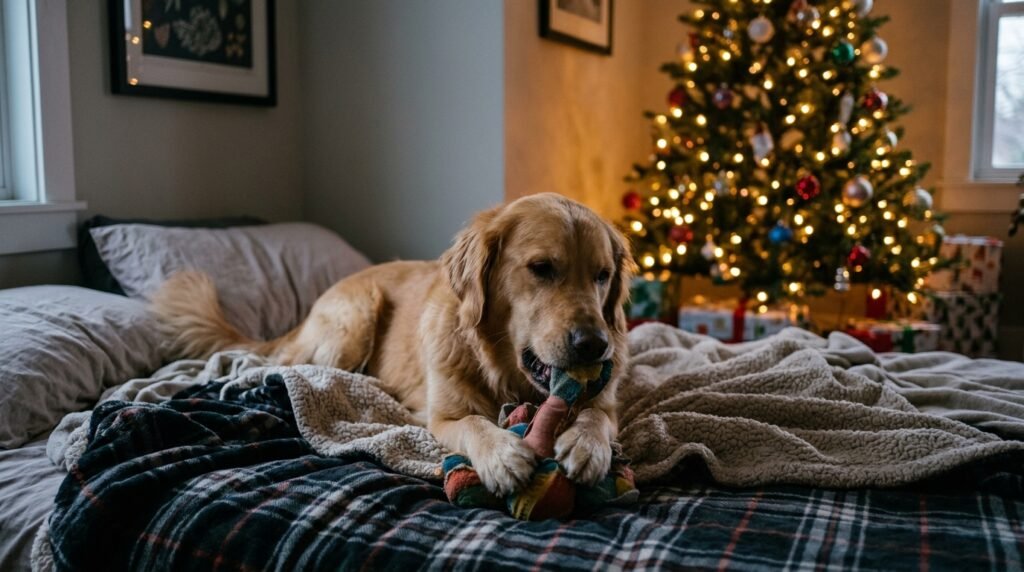
A dog that is bored, full of energy or craving attention is the dog most likely to bother the tree.
- Exercise first. Take a good walk or play before you leave the house or go to bed. A tired dog is much less interested in the tree.
- Offer a chew. When you’re busy in the kitchen or wrapping gifts, hand your dog a long-lasting chew or a stuffed food toy. Placing it on their mat, away from the tree, works nicely.
- Give attention on purpose. Some dogs go to the tree because it makes you react. Give them a few minutes of play so they don’t need to use it to get your attention.
- Don’t leave them alone with it. For puppies and young dogs, supervise the tree or close it off when you aren’t home.
Which Fix for Which Dog?
| If your dog… | Try first |
|---|---|
| Jumps or climbs | Table-top tree, or a tall pen |
| Chews branches | Pet-safe deterrent spray and a barrier |
| Knocks the tree with its tail | Wall anchor and a wider stand |
| Steals ornaments | Bare bottom third, unbreakable decorations |
| Drinks the tree water | Covered stand with a skirt or lid |
| Is a puppy | Closed door or full pen, with supervision |
| Is anxious or very excited | “Place” training and extra exercise |
What If Nothing Works?
Some dogs just don’t leave the tree alone, and that’s okay. You still have good options:
- Put up a small artificial tree on a high shelf.
- Set up your main tree in a room that stays closed.
- Use a wall tree: a tree shape made from garland, lights or branches fixed to the wall.
None of these are failures. They just keep your dog safe while you enjoy the season.
FAQs
Why does my dog keep going to the Christmas tree?
It’s new, it smells different, and it has shiny things at nose level. Some dogs also like the attention they get when they go near it.
Will my dog get used to the tree?
Many dogs lose interest after a few days. Keep the barrier up during that time, and don’t remove it too early.
What smell keeps dogs away from the tree?
Dogs generally dislike bitter smells and tastes, but it varies. Use a product made for dogs, not essential oils or spices.
How do I stop my dog from peeing on the tree?
Block access with a pen or closed door, make sure your dog has had a toilet break before spending time in the room, and clean any accidents with an enzyme cleaner so the smell doesn’t draw them back.
Is it okay to leave my dog alone with the tree?
It’s safest not to, particularly for puppies and dogs that chew. Close the room, or use a full barrier when you’re out.
Final Thoughts
You don’t need a perfect, spotless tree. Pick the right spot, add a barrier, keep the bottom plain and teach your dog a couple of easy cues. If one fix doesn’t work, try another. Most dogs settle down within a few days, and then you can both enjoy the lights.